
Integrations and Automation: the Complete Guide
Connect Vocal Video to the rest of your stack in whatever way suits the job: ask an AI assistant to do the work, have an agent or your own software use our API, or set up an always-on automation with Zapier.
In this article:
- Which option should I use?
- Connect an AI assistant
- Build with the API
- Webhooks for new responses and published videos
- Automate with Zapier
- Embed videos and automate video requests
- What do integrations cost?
Which option should I use?

They all work with the same Vocal Video account, so you can mix them. Pick by what you want to happen:
| You want to… | Use | Plans |
|---|---|---|
| Ask for something in Claude, ChatGPT, Cursor or another AI assistant, and have it done | AI assistant (MCP) | Essential and above |
| Have an agent, a script or your own software read and change things in Vocal Video | API | Pro and above |
| Have your own system notified the moment a response arrives or a video is published | Webhooks | Pro and above |
| Run the same task every time something happens, without AI or code | Zapier | Any paid plan |
| Show videos on your website or online store | Embeds | All plans, including Free |
| Request videos from your own emails, texts or CRM sequences | Collector link | All plans, including Free |
Not sure? Start with an AI assistant. It's the quickest way to try something, and when you find a task you want done every time, move it to Zapier or the API.
Connect an AI assistant (Essential plans and above)
Connect Claude, ChatGPT, Cursor or another AI assistant to Vocal Video, and it can do the same work Vera does inside the app, right from the chat you already use. For example, ask it to:
- Summarize what people said in a collector, or find the responses that mention pricing
- Star the three strongest answers to a question
- Write a video request and send it to a list of people
- Tighten the pauses in a video and mute the filler words
- Give you the share link for a video
Anything that emails real people is previewed first, and your assistant asks before it sends.
To connect:
- In Vocal Video, go to Settings > Connect AI Assistant (MCP) and copy the server URL.
- Add the URL to your assistant as a custom connector.
- When your assistant opens a Vocal Video sign-in, log in, choose a workspace and click Allow.
Each assistant adds connectors a little differently. Follow the step-by-step guide for yours: Connect Claude, Connect ChatGPT, or Other MCP clients (Claude Code, Cursor and more).

Your assistant works as you, in the workspace you chose. Teammates each connect with their own Vocal Video login, so there's nothing to share.
Build with the API (Pro plans and above)
Our API gives your own software the same tools Vera uses, so it can read responses, send video requests, build videos and manage collectors. Use it for anything that should run without a person in the chat, like a nightly sync to your CRM or a step in your own app.
You don't have to write the code yourself. A coding agent like Claude Code or Cursor can build an integration for you: describe what you want, and point it at our developer docs, which include a machine-readable reference for agents to work from.
To get started:
- Go to Settings > API Keys and click Create key.
- Choose Read only or Read/Write. Pick Read only unless your integration needs to change things.
- Copy the key somewhere safe, then follow the API Quickstart.
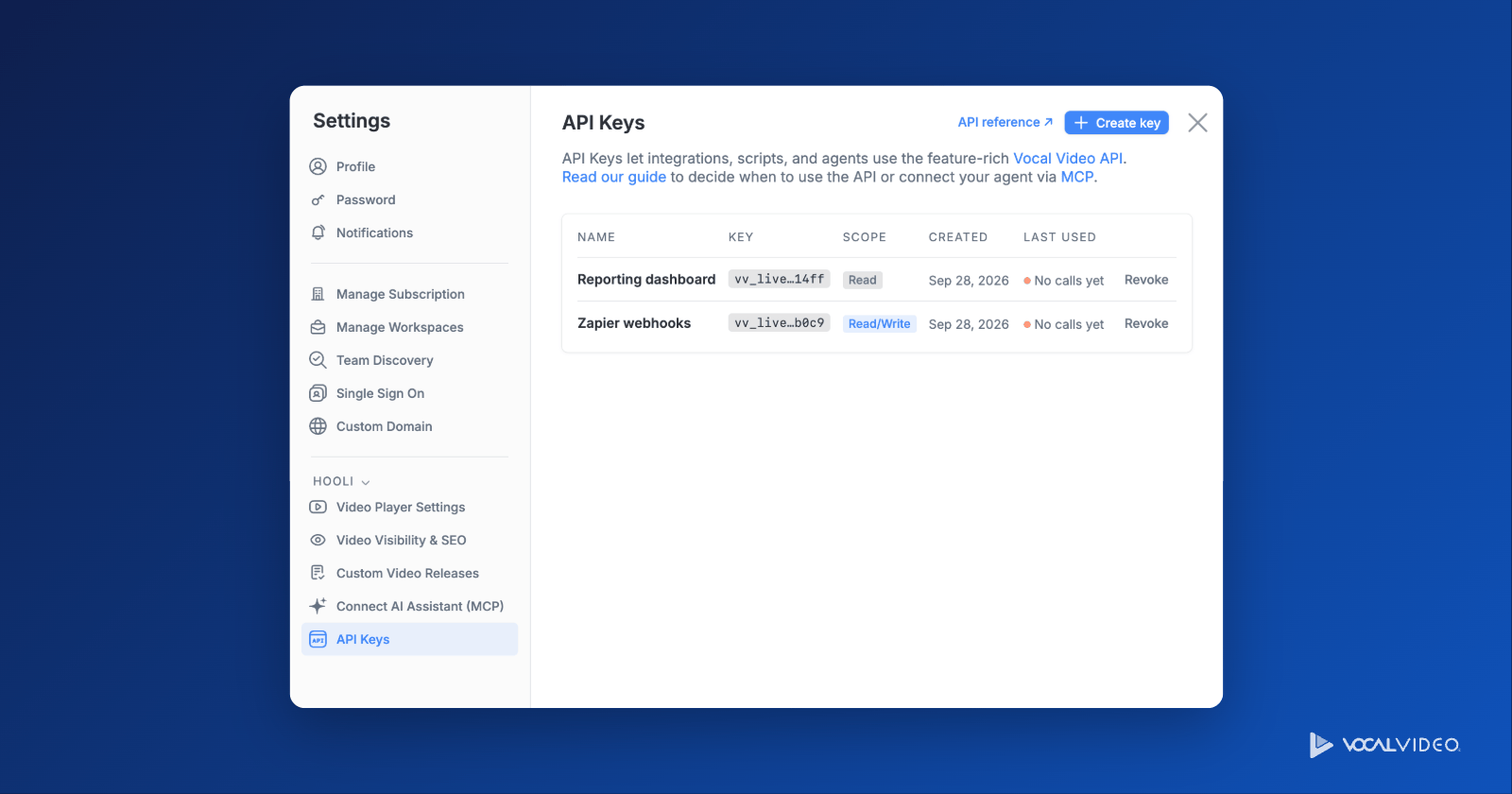
A key works in one workspace and acts as the person who created it.
Webhooks for new responses and published videos
The API answers when your software asks. To have Vocal Video tell your system the moment a response comes in or a video is published, register a webhook with our Subscription API. See Creating a Custom Integration With Our Subscription API and Webhooks.
Automate with Zapier (paid plans)
For a task you want done the same way every time, Zapier connects Vocal Video to 6,000+ apps without code, and runs on its own once it's set up. Post new responses to Slack, sync respondents to your CRM, or back up every published video to Google Drive. Our integration directory has 100+ ready-made templates, and Zapier is built into Vocal Video, so you never have to leave the app.

For examples, setup steps, collector integrations and managing your Zaps, see Automating Vocal Video with Zapier.
Embed videos and automate video requests (all plans)
Embeds: Put your videos and galleries on your website or online store as a gallery, carousel, slideshow, wall of love or list. When you add videos to a gallery later, the embed updates on its own, with no new code. See How to Share and Embed Videos and Adding Vocal Video Embed Codes to Your Site.
Automated video requests: Every video collector has a link, so you can request videos from any email sequence, text message or CRM workflow you already run. See How to Request Videos.
What do integrations cost?
- Embeds and automated video requests: all plans, including Free.
- Zapier: any paid Vocal Video plan, plus a Zapier account. For most apps a free Zapier account is enough.
- AI assistant (MCP): Essential, Pro, Scale and Enterprise plans.
- API and webhooks: Pro, Scale and Enterprise plans.
Does connecting an AI assistant use AI credits?
Not on its own. Your assistant's conversation runs on your assistant's plan, and most of what it does in Vocal Video is free. Two things spend credits, just as they do in the app: AI-directed templates and videos with AI effects. See AI Credits: What Uses Them and What Happens When You Run Out.
For more information see:
Still need help? Contact Support at support@vocalvideo.com