
Transcripts and Captions in Vocal Video
Vocal Video automatically creates transcripts and captions for every response you collect, and for every video you create or upload.
Your transcript is much more than a block of text: it's how you edit your videos, how captions stay accurate, and how you turn spoken words into quotes, captions files, and written content.
This article covers how transcripts are created, how transcript-based editing works, how to edit and alter captions, and how to view, copy, and download transcripts for published videos.
How Your Videos Get Transcribed
There's nothing to set up. Every video and audio response recorded through a Video Collector — and every video you upload — is transcribed automatically while it's being processed. By the time your response is ready to view, the transcript is too.
To see the transcript for any response, just click on it: the transcript appears to the right of each video clip.
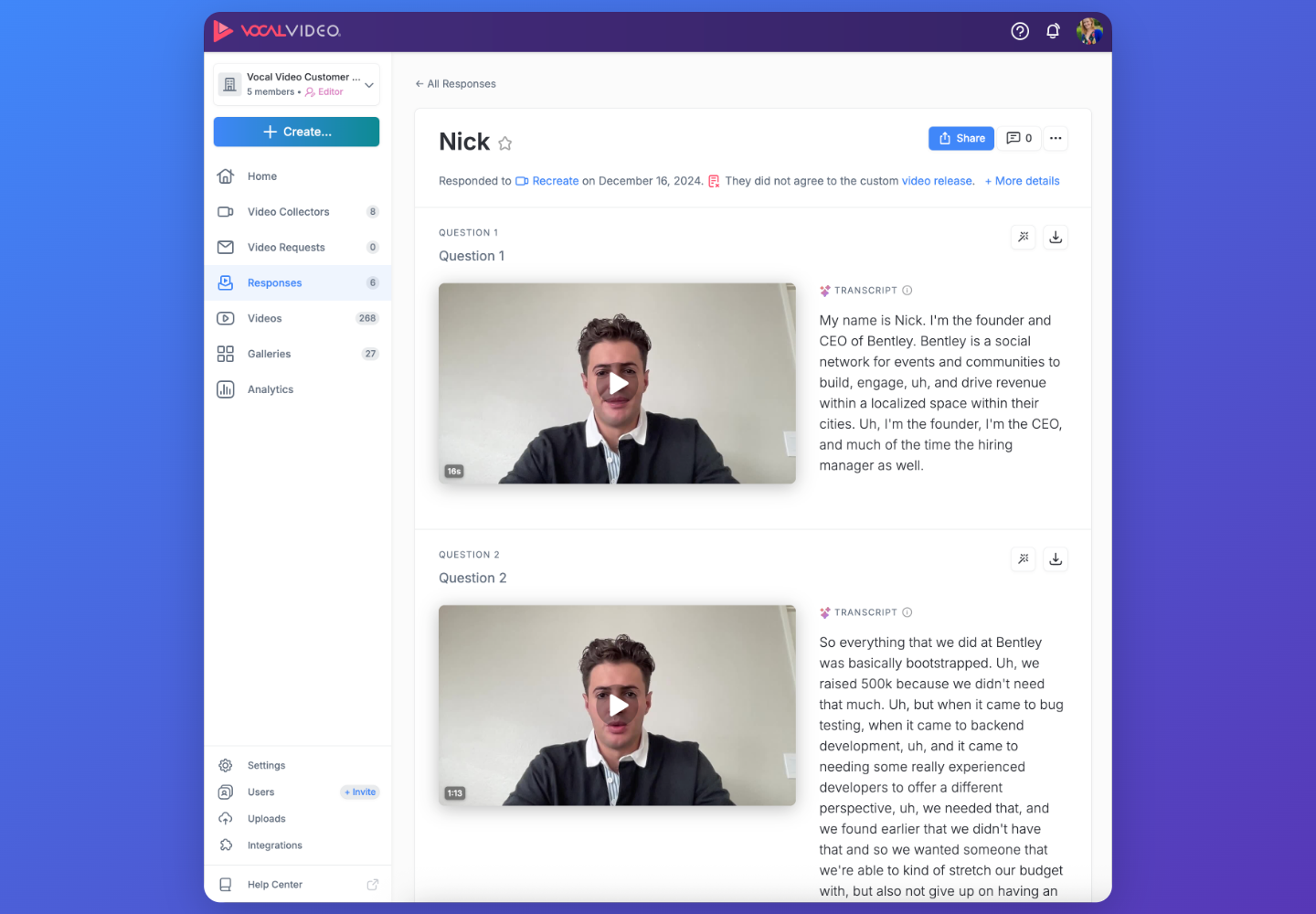
Vocal Video automatically detects the language being spoken, so respondents can answer in their own language and the transcript will match. To collect responses in another language end to end — including the recording experience itself — see Localizing Video Collectors, Transcripts and Subtitles.
Edit Your Video by Editing the Transcript
Here's where transcripts get powerful: in the Vocal Video editor, the transcript is how you edit the video itself. No timeline scrubbing required — if you can edit text, you can edit video.
Open any video in the editor and you'll see the transcript for each scene in the left-hand panel. Click a word to jump the playback to that exact moment, or select a word or phrase to act on it:
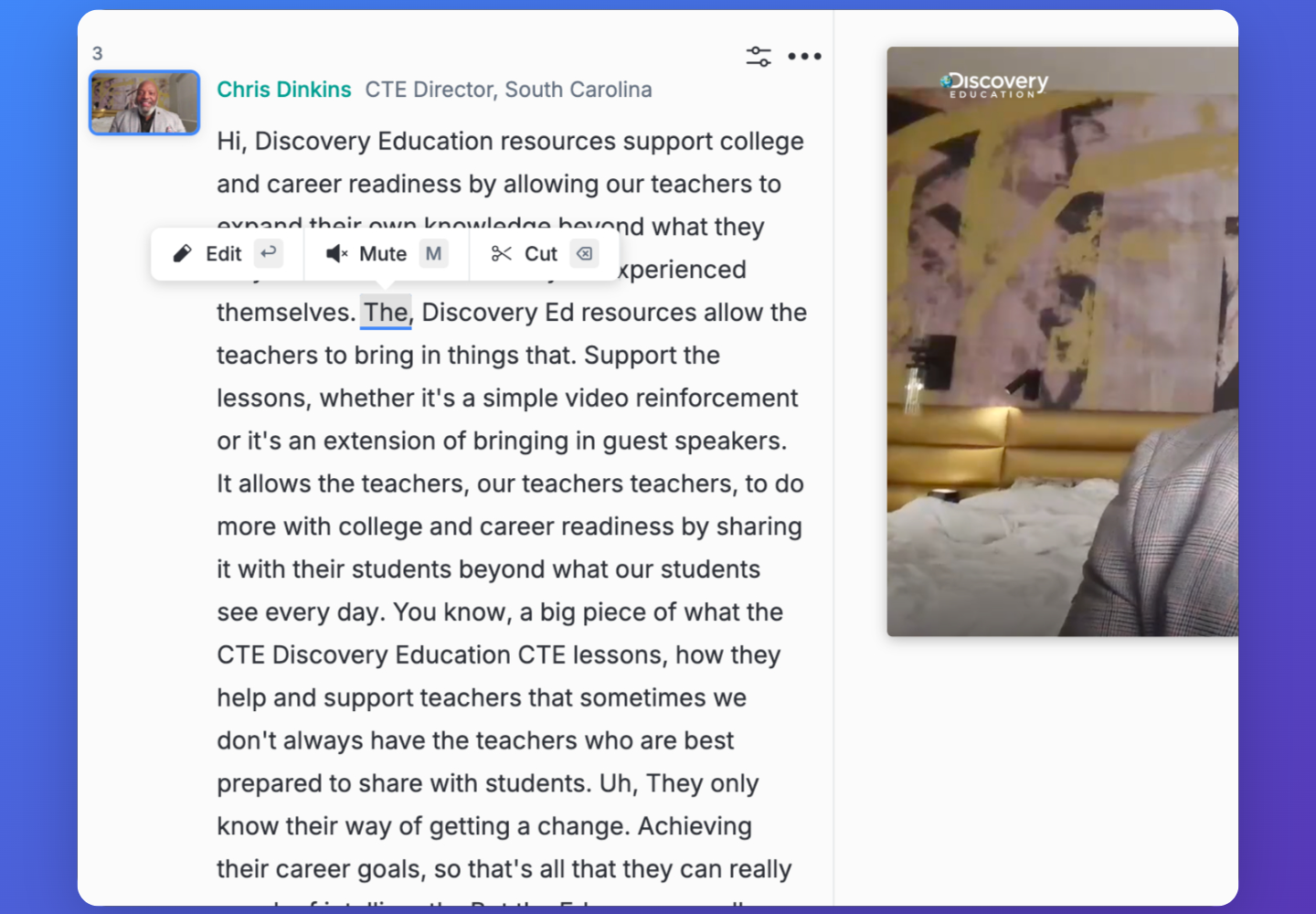
- Edit will change the transcript and captions for the video, but will leave the video itself unchanged. Perfect for fixing misheard words, names, and punctuation.
- Mute will remove the word(s) from the transcript and silence the speaker's voice during those words.
- Cut will remove the word(s) from the transcript and captions AND will automatically edit that portion out of the video — as easily as deleting a sentence from a document.
Nothing is destructive: cuts can be restored at any time, and every change can be undone.
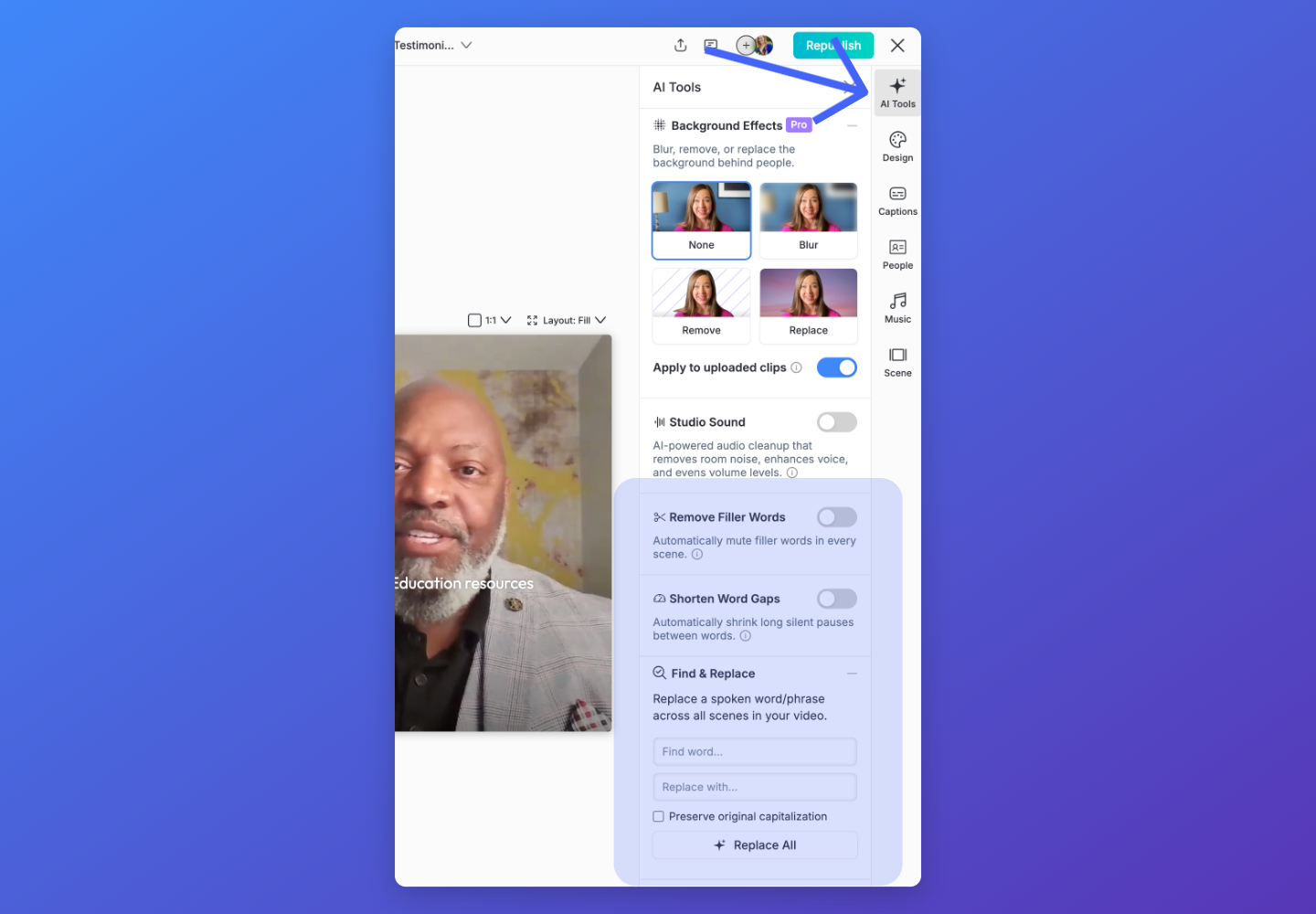
Automatic cleanup. Two AI tools polish your videos through the transcript, and both live in the AI Tools panel in the right-hand toolbar:
- Remove Filler Words automatically mutes the "ums," "uhs," and "hmms" in your responses. It's on by default (it comes from your default template); turn it off in AI Tools if you'd rather keep every word.
- Shorten Word Gaps tightens long pauses between words, with an adjustable threshold — great for making responses feel crisp without cutting anything a speaker said.
Both are AI effects, so a video that uses either one spends AI credits the first time you publish it. See AI Credits: What Uses Them and What Happens When You Run Out.
Fixing recurring errors. If the same word is mis-transcribed throughout (a person's name, a company name), double-click any word to correct it in place — or use Find & Replace in the AI Tools panel to fix every occurrence across the whole video at once.
💡 This is just the overview. For the complete guide to transcript-based editing — keyboard shortcuts, adjusting mute timing, restoring cuts, and transcript view modes — see Using the Vocal Video Editor.
Captions That Stay in Sync
In addition to the automatic transcript, Vocal Video automatically creates captions for your published videos — and because captions are generated from the transcript, any edit you make to the transcript automatically updates the captions too. Fix a name once, and it's fixed everywhere.
To style your captions, click Captions in the right sidebar of the editor. Use the switch at the top of the panel to turn captions on or off. Then:
- Presets: choose from 30 caption styles, from minimal ones that stay out of the way to animated, word-by-word styles for social video. Theme Default follows your video theme's own typography.
- Customize: fine-tune any preset, including caption position and size, font, how the word being spoken is highlighted, colors, background and motion.

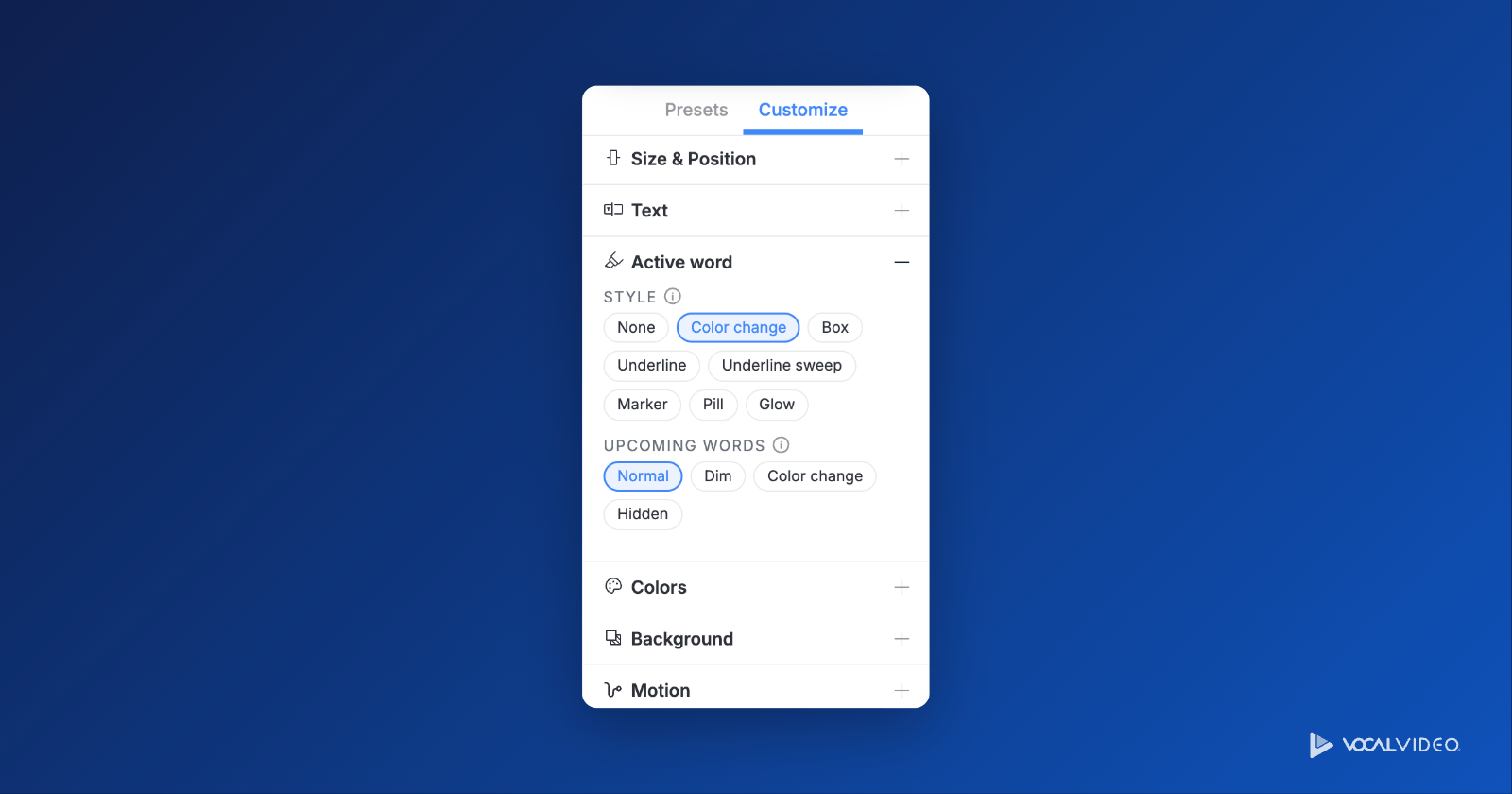
For every setting, step by step, see How to Edit Captions and Attribution.
Captions are rendered directly into your published video, so they appear everywhere the video plays — embeds, social media, downloads — with no setup required from your viewers. If you need a separate captions file for another platform, you can download an SRT file from the published video page — see below.
Transcripts for Published Videos: View, Copy & Download
To see the transcript for any published video, click on the video in your account. The full transcript, labeled by speaker, appears on the page below the video. From this page you can:
- Copy the entire transcript with one click
- Download the transcript as a text file (TXT)
- Download the captions as an SRT file, ready to upload to YouTube, LinkedIn, or any platform that accepts caption files
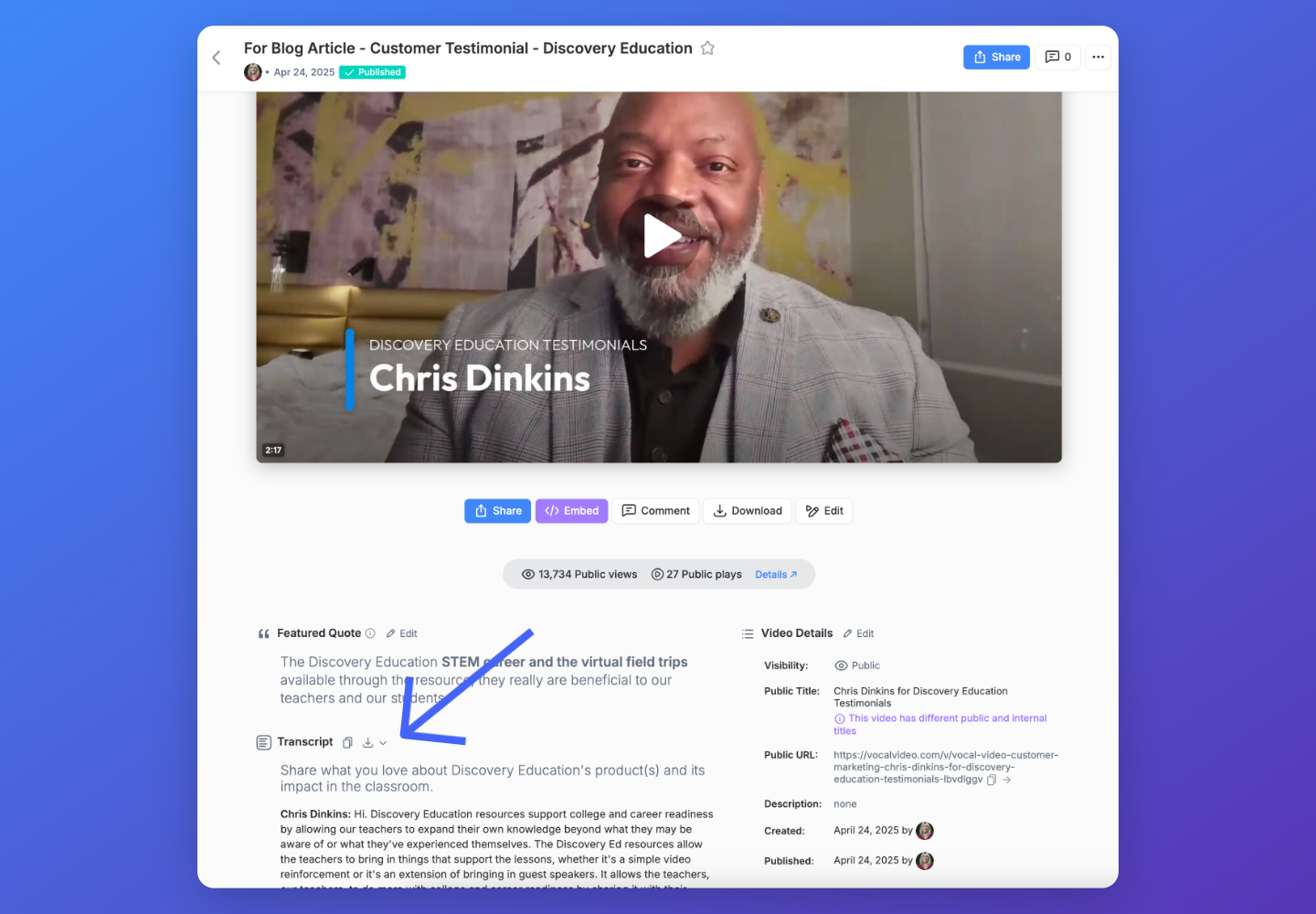
Viewers of your published video see the transcript below the video on its public page, too — so your content is readable as well as watchable.
More Ways Transcripts Work for You
- Search your library by what was said. Every transcript is searchable, so you can find any response by keyword — even across hundreds of videos.
- Quotes and highlights. Featured quotes and AI-powered suggestions are drawn from your transcripts.
- Repurpose your content. Copy a transcript straight into case studies, blog posts, and social captions. Vocal Video's own Customer Stories are video transcripts that have been copy-edited and turned into blog posts!
FAQ
Why isn't the transcript perfect? We rely on the latest Amazon AI technology, so accuracy is always improving. With a clear speaker, it gets very close — and when it misses, a double-click fixes any word, or Find & Replace fixes a recurring error everywhere at once.
What languages are supported? Vocal Video automatically detects the language being spoken and transcribes in that language. To localize the full recording experience for your respondents, see Localizing Video Collectors, Transcripts and Subtitles.
Can I translate a transcript or captions into another language? Not currently — transcripts and captions are in the language spoken in the video.
If I edit the transcript, does it change my video? Only if you want it to. Edit changes text only; Mute and Cut change the video's audio and footage. See Using the Vocal Video Editor for details.
Can I change the caption font? Yes. In the video editor, open Captions > Customize > Text and choose a Font; the colors are under Colors on the same tab. To set the caption style new videos start with, set it in your default template. See Set your caption style in a template.
Can I upload my own transcript or SRT file? Not at the moment.
Where do I download the transcript or SRT? From the published video's page in your account — not from within the editor. Publish (or republish) your video first, then use the download menu below the video.
Why doesn't my published video's page show a transcript? The transcript appears on the public video page when captions are enabled for that video. If you've turned captions off, the transcript won't be shown publicly.
Does Vocal Video's automatic transcription use AI credits? No.